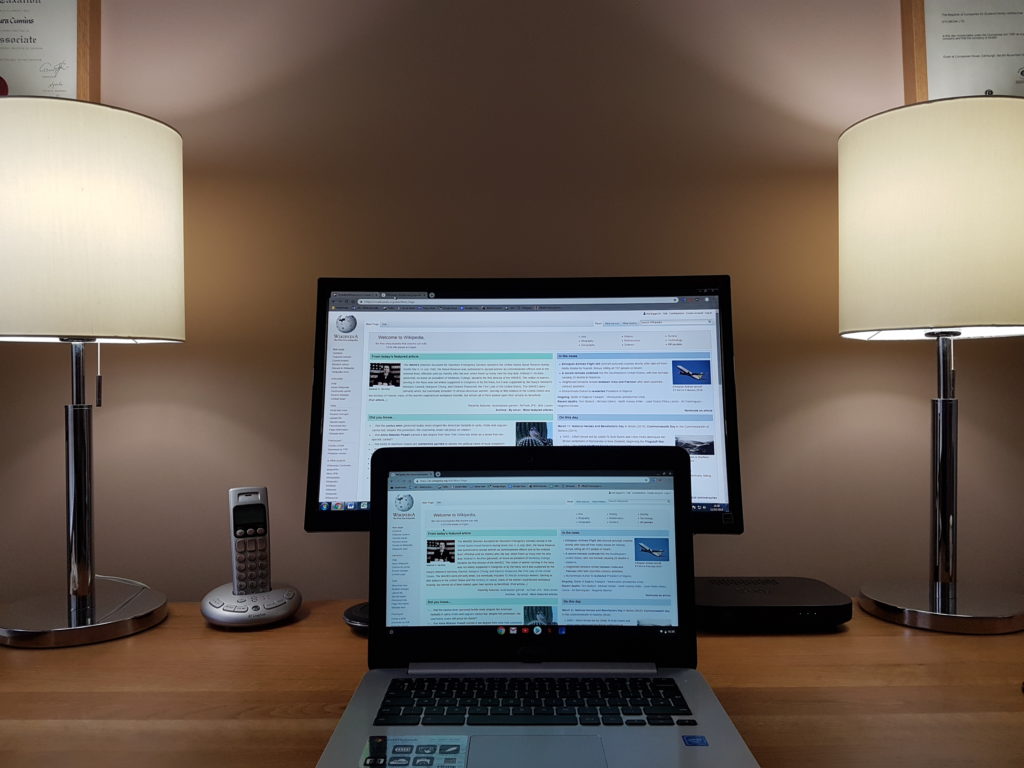
We are currently living under unprecedented professional, personal and social restrictions, whose consequences could take decades to fully understand and repair. For anyone struggling to cope during this oppressive and uncertain time, I’ve published an article with some advice on preserving mental health. You can read it here – https://www.linkedin.com/pulse/preserving-mental-health-during-difficult-times-neil-cumins/
At the time of writing, the UK is experiencing the unwelcome advance of the Coronavirus, or COVID-19. Sporting events are being suspended, festivals are being cancelled, and commuters are nervously applying hand sanitiser while sweating underneath stifling face masks. We’re being encouraged to avoid large public gatherings and refrain from unnecessary travel, while consumers panic-buy toilet roll and shysters try to sell us 49p bottles of antibacterial gel on eBay for £25.
At this stage, it’s impossible to know how far COVID-19 will
spread, or how serious its repercussions will be. However, the latest
Government advice is to work from home if possible. And that has raised a wider
debate about why millions of people struggle through chaotic rush-hours to
reach an inconvenient place for an arbitrary time, to sit at a desk and email
people sitting six feet away. Accountancy firm KPMG is running a trial where
many of its staff work from home on Fridays, to see whether productivity is
affected. In fact, there’s a good chance productivity will increase, since
people will be committed to making the trial a success. Plus, they’ll feel more
energetic and less fatigued without an early-morning commute…
No place like home
It’s a shame that it’s taken the Coronavirus outbreak to make
employers question the necessity of making staff sit in an office all day. The
benefits of home working certainly aren’t lost on me. Exactly ten years ago, I quit
the safety of a full-time job as a property journalist to become a full-time
freelance writer, running my fledgling copywriting agency from a spare bedroom in
East Kilbride. That didn’t just mean surrendering a guaranteed salary, a
pension scheme and a chance to chat about last night’s episode of Homeland
while the kettle boiled. It also meant giving up an expensive and frustratingly
slow commute into a draughty and noisy office in an industrial estate, and then
repeating the process in reverse when I was tired and it was getting dark. And
although the ability to dramatically reduce my exposure to airborne pathogens wasn’t
a key factor behind establishing G75 Media, avoiding other people’s germs is
one of many advantages to working from home.
Of course, some professions lend themselves to home working
better than others, and not everyone has the flexibility a freelance writer
enjoys. Doctors can’t squirrel themselves away in their spare rooms, though
they could potentially make greater use of video calls. Taxi drivers still have
to collect passengers, albeit with their windows open and a box of tissues handy.
And nobody expects police officers or firefighters to log on remotely. Yet
millions of people could base themselves at home for at least part of the
working week, from call centre staff to architects. And if they did, they might
discover the following benefits:
More time. How many hours would you save by not having to endure ten rush-hour journeys every week? You could spend some of this extra time doing additional work, some of it taking proper breaks from your desk, and the rest enjoying quality time with family and friends.
Less distractions. Office camaraderie can be enjoyable, but small talk and blaring radios become a distraction if you’ve got a deadline to meet. Large offices can be antithetical to productivity, with constant interruptions and background noise. Being based at home may provide greater freedom to concentrate – helping you to be more productive and efficient.
Greater flexibility. The concept of working from 9am to 5pm with a one-hour lunch break seems archaic in today’s 24-7 global culture, yet this 19th century hangover persists through sheer inertia. Many people work better at other times of day, don’t want a full hour for lunch, or would benefit from more flexible working hours due to family commitments.
Better breaks. Isn’t it annoying when you have to wait ten minutes to use the solitary microwave because someone’s cooking a baked potato? At home, you can eat and drink whatever you want, whenever you want. No more stolen milk, no more fixed break times, and no more offending everyone around you as you unwrap an egg mayo baguette.
Same. But different.
Many people are surprised to discover how much of their
working week relies on technology, rather than proximity. We’ve all emailed colleagues
sitting within a few metres of us, driven to meetings which would have been equally
productive as a Skype call, and printed off emails to hand out when simply forwarding
the email would have saved paper and ink. Collaborative workplace tools like
Slack and Trello make project management easier than the traditional
whiteboard-and-weekly-meeting approach, and email remains the finest method of
data distribution ever invented.
As a freelance writer, I am typing this blog on a laptop at
home, which I could relocate anywhere with a decent WiFi connection. According
to Google Analytics, you are probably reading it on a portable device – another
laptop, a tablet or a smartphone. And while any of us could potentially
contract an airborne virus like COVID-19, my ability to avoid public transport while
picking and choosing when I leave the house should reduce my risk of (a) being
infected and (b) unwittingly infecting other people.
If you’re an employer reading this, it’s worth considering the
extent to which you could permit staff to work from home. If you’re an
employee, consider what (if any) parts of your job may be achievable while
being based at home, and suggest it to your line manager. And if you want to
enjoy the benefits of high-quality content production by an award-winning
freelance writer, from blogs and listicles through to opinion pieces like this
one, drop me an email or give me a call. You don’t need to arrange a
face-to-face meeting to benefit from G75 Media’s copywriting and content
production services.
The start of a new decade provides an ideal opportunity for reflection and analysis on the decade just passed. And while 2019 proved to be a turbulent year politically and a disruptive one technologically, it was also an eventful one for writers and journalists. Our industry has changed so much since January 2010 that it’s worth taking a moment to consider how the art of copywriting and journalism has changed since we last welcomed in a new decade…
Copywriting and journalism changed almost as much as technology in the 2010s
Putting the word out
Ten years ago, the internet was absent from millions of
UK homes, and many people still relied on dial-up connectivity. Websites had already
evolved away from early experiments with Comic Sans fonts and animated GIFs,
but there was little video content, and photography platforms remained niche.
Instead, the written word was king – particularly given the growing importance
of search engine optimisation, or SEO.
By the middle of the last decade, websites were
experimenting with the potential offered by home broadband connectivity. Parallax
scrolling, single-page websites and auto-playing video content became briefly
fashionable on many corporate websites. However, 4G’s arrival in 2013 triggered
meteoric growth in mobile internet services, which literally and metaphorically
rendered flashy (or Flash-y) sites unsuitable for a smartphone. As a result, we
came full circle, relying on professionally-written copywriting and journalism to
underpin any successful website.
Make it a large one
More recently, Google and Bing have emphasised the
importance of long-form content. The days when a 500-word blog provided optimal
SEO benefits have passed. And while we’re not going to extend this article to be
5,000-8,000 words long (which search engines increasingly regard as
demonstrating authoritative content), long-form copywriting and journalism
makes up a growing percentage of G75 Media’s monthly workload.
The last decade also saw the inexorable rise of the blog.
Although Blogger debuted in 1999 and WordPress launched in 2003, blogging only really
took off towards the end of the Noughties. By 2010, there was huge demand for freelance
bloggers, and G75 Media began offering blogging as a service. At the time, IT
and technology clients were identifying blog archives as a way of boosting
keyword recognition among search engines, and two of G75 Media’s biggest
clients still depend on us for weekly blog content.
Another trend which dominated the 2010s was the welcome
increase in flexible working. Brands like WeWork have revolutionised the concept
of office space, and millions of Britons now work from home either part-time or
full-time. Copywriting and journalism are ideal sectors for both freelancing
and working from home, since employers can call on specialist writers as and
when their services are needed. Many of G75 Media’s clients will contact us
once a year or even less frequently, knowing we can quickly and effectively
deliver copywriting and journalism to meet any brief.
Goodbye and good riddance
Other trends rose and fell with equal rapidity, such as
overseas copywriting firms. Agencies popped up around the world, offering cheap
online copywriting for corporate clients. Almost as a rule, these firms
delivered fairly dreadful content. Their writers generally spoke English as a
second language, their proofreading and editing skills were negligible, and the
balance of keywords and long tails (key elements of SEO) was usually wrong.
When Google and Bing began downgrading websites with lazily-written content supplied
by overseas copy farms, the writing was on the wall – but not on the websites.
The phenomenon quickly died out as companies realised it simply isn’t worth paying
for cheap copywriting and journalism.
More recently, we have also seen the welcome decline of
academic writing websites. These enabled lazy students to outsource
dissertation and essay writing to ‘qualified professionals’. Like all
respectable content production agencies, G75 Media flatly refused to get
involved in this distasteful practice, despite being approached on a number of
occasions with unsolicited requests for assistance. Our copywriting services
have always been ethical and honest, and they always will be.
Taking care of business
Despite these unwholesome sub-sectors of copywriting and
journalism, the internet’s meteoric growth came at a great time for a business which
was founded in 2007 as a dedicated copywriting agency. In February 2010, G75
Media’s founder Neil Cumins made the decision to quit his part-time day job as
a property journalist and become a full-time business owner, freelance
copywriter – and property journalist! Having retained his former estate-agency employer
as a client, the process of building a successful copywriting agency could
begin.
Today, G75 Media regularly works with clients on three
continents, from America to Australia. We employ freelance writers whose areas
of expertise dovetail with our client base. We deliver everything from
listicles and social media content through to white papers and how-to guides
for clients as diverse as manufacturers, optometrists and tourism firms. And as
we enter our third decade as a limited company, G75 Media is proud to be a
copywriting agency with few peers.
But why stop there? A new decade brings new
opportunities, while our greater resources and superior expertise should ensure
we’re able to continue growing and expanding throughout the 2020s. We don’t
know what the last decade will be referred to as – possibly the Tens or the Teens
– but it’s been the making of G75 Media. Here’s to another decade of
award-winning copywriting and journalism.
The philosophy behind fake reviews is the polar opposite of everything G75 Media stands for
The thorny subject of fake reviews has been in the media
recently, with allegations about false five-star reviews on Amazon and
interviews with self-confessed fake review writers. There has also been a
greater focus on falsifying academic records on both sides of the Atlantic,
coupled with a crackdown on dissertation writing firms.
Fake content is a topic G75 Media feels very strongly
about, since trust is a cornerstone of our copywriting services. Before getting
into the specifics of why this matters, it’s important to clarify our position
on fake reviews:
We have never sought or published fake reviews for any of our online profiles or accounts. As a result, you’ll occasionally see other copywriting agencies ‘scoring’ more highly than us on review sites, even though a cursory glance at their websites and marketing materials might not suggest they’re the best in the business.
We’ve never written a glowing testimonial that we didn’t wholeheartedly stand by. We rarely review service providers; if we do, it’s because our experience justifies it. If we have criticisms, we tend to address them directly to the company or individual, giving them a reasonable chance to address these issues.
When writing on behalf of clients, we deliberately avoid belittling and bad-mouthing their competitors. Even when a rival brand is clearly falling short of the standards our clients have set, we promote the latter’s achievements rather than denigrating the former. Negative advertising should be left in the 1980s, where it belongs.
We don’t use social media as a steam valve or echo chamber. Like everyone reading this article, we’ve had good and bad client experiences in recent times. Unlike some people, we don’t resort to splashing hyperbolic language over social media platforms. At worst, we’ll discuss any marketing lessons to be learned from high-profile failures.
Our word is our bond
The cynic might wonder why any of this matters. After
all, consumers know fake reviews exist. We recognise the temptation to use
emotive phrases like “ruined” and “worst ever” to illustrate disappointment or
frustration. And it’s hard to escape the fact that copywriting is a cut-throat
industry, where earning any form of income is often challenging.
However, some things are more important than boosting
your monthly turnover, or filling the working week with projects. Fake reviews
are deceitful, and false writing of any kind is morally unjustifiable. If you
spend your days writing fraudulent reviews for products and services you’ve
never experienced, you’re effectively a professional liar. Anything you
subsequently say will be tainted by association, and you’re also making life
harder for everyone who still places their trust in online content.
In a virtual world where the senses of touch, smell and taste are non-existent, the written word is all-powerful. Abusing it for short-term corporate gain is as unforgivable as it is unacceptable. While positive PR and promotional content inevitably only tells one side of the story, at least these stories are rooted in fact. That’s where the true power of written communications comes from, and it’s something G75 Media will continue to champion in every article, blog and promotional feature we produce.
If you’ve ever struggled with mental health, your smartphone and social media accounts might be contributory factors. G75 Media’s founder Neil Cumins explains in his latest LinkedIn blog post why the cure has increasingly become the condition, suggesting ways to reduce the burden on our overheated minds…
After a strenuous year at the copywriting coalface, G75 Media will be closing its doors tonight. We’ll be returning to action on Thursday January 3rd. In the meantime, have a wonderful Christmas and New Year – and get in touch if you’d like any assistance with copywriting, content production, journalism or web copy…
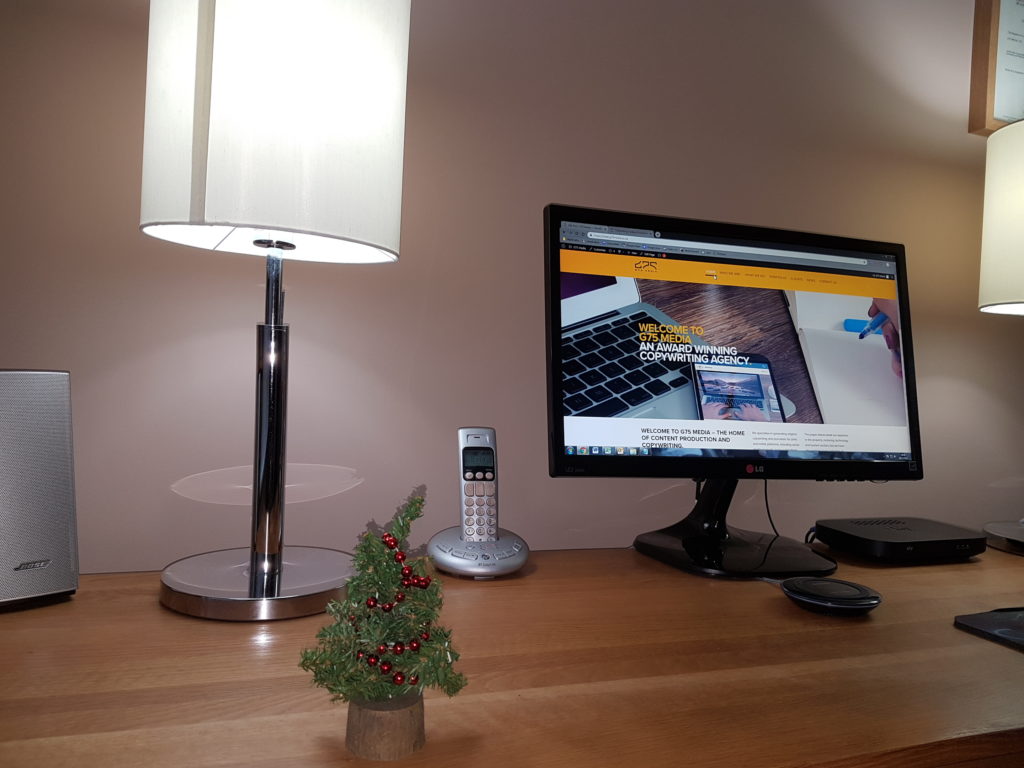
It’s beginning to look a lot like Christmas in the G75 Media office…
The G75 Media website has recently gained HTTPS accreditation, protecting site visitors against malicious activity while they’re on our site. After ten years using the standard HTTP protocol, last week’s upgrade reflects our commitment to ensuring everyone can browse our portfolio of published articles (or submit an enquiry about our copywriting services) in complete safety.
HTTPS websites encrypt information before it’s transmitted to the web browsers of individual visitors. This ensures any traffic between our server and the device you’re reading this on is protected against eavesdroppers and cyber-criminals. You’ll often see HTTPS preceding retail or ecommerce web addresses, where financial data is being exchanged and eavesdroppers would have a field day.
Even though our content production and copywriting services are highly celebrated, online criminals probably wouldn’t try to exploit your visit to our site today. Or would they? After all, the G75 Media website was created using the world’s most popular content management platform. Its sheer popularity makes WordPress a favoured target for spam and malware developers. WordPress software plugins are also susceptible to newly-launched malware – known as zero day attacks.
As part of the EU’s new General Data Protection Regulation, G75 Media has to meet strict standards regarding the storage and management of client data. Elevating our website to HTTPS standard demonstrates our commitment to this process. It also places us ahead of many other content production agencies and media firms, who also lack our extensive client roster. A number of our copywriting agency rivals are still using HTTP, resulting in “Not secure” tabs appearing in Chrome or warning messages flashing up in Firefox. We take your safety a little more seriously.
If you already understand the principles of zero day attacks and end-to-end encryption, you might want to get in touch regarding our technical writing and technology journalism services. But don’t worry if we lost you after “standard protocol”. We’ve got everything secured.
Later this month, the EU will roll out its General Data Protection Regulation. After four years of development, GDPR will effectively replace the UK’s 1988 Data Protection Act. As such, it will place additional regulatory burdens on companies retaining any client information on file. This can range from the names and email addresses of corporate contacts to bank account details and social media posts.
At G75 Media, we take these responsibilities very seriously. We are preparing for GDPR’s introduction on Monday the 25th, and these are some of the steps we’re introducing to protect and preserve the confidentiality of client data:
• From today, every email we send will contain an invitation to unsubscribe from future correspondence. If you reply with the word ‘unsubscribe’ in the subject line, we will immediately delete any contact information we hold relating to you.
• If six months has elapsed since we last worked with you, we will archive any sent or received electronic documentation. Data will be saved on a password-protected USB key with AES 256-bit encryption, which is stored offline in a safe.
• Current documentation and related client data (including email addresses) is stored on a password-protected drive of a desktop computer equipped with sophisticated antivirus software. We do not share client data with anyone, in any circumstances.
• Any historic databases or spreadsheets of contact information we previously held have all been deleted. This ensures any information provided to us by former clients has been securely destroyed.
• If you contact us via telephone, email, post, text message or social media, we will only communicate with you regarding work-related briefs or assignments. We will never send you marketing emails, event invitations or other unsolicited sales missives.
• We’re working towards a paperless office, and we never print out emailed documentation. Any paperwork we do receive is securely stored in a locked building until it’s no longer needed, at which point it’s destroyed in a cross-cut shredder.
We recognise there is a great deal of confusion about GDPR and its effect on small businesses around the UK. As technology bloggers, we have already been commissioned to produce a number of features on GDPR and its impact, so it’s a subject we’re familiar with. However, if you have any concerns about how we use or store client data, please don’t hesitate to ask.
Finally, if you’ve found this page while searching for information on GDPR, G75 Media has produced a number of practical guides on behalf of clients on both sides of the Atlantic. If you’d like content creating for your own company, we’ll be happy to provide you with a quote – in strict confidence, and with full adherence to GDPR regulations! You can get in touch with us here.
While the rest of the UK enjoys a welcome (if rather chilly) Easter bank holiday weekend, work continues at the copywriting coalface for G75 Media. In our new role as copy editors of a national magazine, there are articles to be revised and proofread in preparation for next week. We have the usual turntable of weekly deadlines to be met – even if copy that our clients would normally upload on Monday won’t be seen til Tuesday! And there’s also the small matter of entering a national competition for freelancers, with our entry ready to be uploaded. If we’re nominated, you’ll hear about it here first…
After a thoroughly enjoyable break over Christmas, G75 Media has returned to a packed inbox and a busy schedule. Our first January job involves producing consumer advice articles for one of the UK’s leading price comparison firms. We’re currently writing four features a week for this client, providing practical advice about mobile phone contracts, broadband accounts and on-demand services.
We work with IT and computing firms on both sides of the Atlantic, writing everything from keyword-driven blogs to in-depth white papers and infographics. G75 Media’s founder Neil Cumins grew up in a family of amateur programmers and created his own art package in BASIC at the tender age of 13, so computing has always been an area of personal expertise. By researching topics like website hosting, WordPress and cybersecurity on a weekly basis, creating original content on these subjects has become as intuitive as writing about games consoles or streaming media services.
If you need any assistance with technology writing, consumer advice journalism or any other form of digital media content, get in touch with G75 Media for a quote. Wherever you are in the world, we’ll be able to find the right words for your products and services.
We use cookies on our website to give you the most relevant experience by remembering your preferences and repeat visits. By clicking “Accept”, you consent to the use of ALL the cookies. However you may visit Cookie Settings to provide a controlled consent.
This website uses cookies to improve your experience while you navigate through the website. Out of these cookies, the cookies that are categorized as necessary are stored on your browser as they are essential for the working of basic functionalities of the website. We also use third-party cookies that help us analyze and understand how you use this website. These cookies will be stored in your browser only with your consent. You also have the option to opt-out of these cookies. But opting out of some of these cookies may have an effect on your browsing experience.
Necessary cookies are absolutely essential for the website to function properly. These cookies ensure basic functionalities and security features of the website, anonymously.
Cookie
Duration
Description
cookielawinfo-checbox-analytics
11 months
This cookie is set by GDPR Cookie Consent plugin. The cookie is used to store the user consent for the cookies in the category "Analytics".
cookielawinfo-checbox-functional
11 months
The cookie is set by GDPR cookie consent to record the user consent for the cookies in the category "Functional".
cookielawinfo-checbox-others
11 months
This cookie is set by GDPR Cookie Consent plugin. The cookie is used to store the user consent for the cookies in the category "Other.
cookielawinfo-checkbox-advertisement
1 year
Set by the GDPR Cookie Consent plugin, this cookie is used to record the user consent for the cookies in the "Advertisement" category .
cookielawinfo-checkbox-necessary
11 months
This cookie is set by GDPR Cookie Consent plugin. The cookies is used to store the user consent for the cookies in the category "Necessary".
cookielawinfo-checkbox-performance
11 months
This cookie is set by GDPR Cookie Consent plugin. The cookie is used to store the user consent for the cookies in the category "Performance".
viewed_cookie_policy
11 months
The cookie is set by the GDPR Cookie Consent plugin and is used to store whether or not user has consented to the use of cookies. It does not store any personal data.
Functional cookies help to perform certain functionalities like sharing the content of the website on social media platforms, collect feedbacks, and other third-party features.
Performance cookies are used to understand and analyze the key performance indexes of the website which helps in delivering a better user experience for the visitors.
Cookie
Duration
Description
_gat
1 minute
This cookie is installed by Google Universal Analytics to restrain request rate and thus limit the collection of data on high traffic sites.
Analytical cookies are used to understand how visitors interact with the website. These cookies help provide information on metrics the number of visitors, bounce rate, traffic source, etc.
Cookie
Duration
Description
_ga
2 years
The _ga cookie, installed by Google Analytics, calculates visitor, session and campaign data and also keeps track of site usage for the site's analytics report. The cookie stores information anonymously and assigns a randomly generated number to recognize unique visitors.
_gid
1 day
Installed by Google Analytics, _gid cookie stores information on how visitors use a website, while also creating an analytics report of the website's performance. Some of the data that are collected include the number of visitors, their source, and the pages they visit anonymously.
Advertisement cookies are used to provide visitors with relevant ads and marketing campaigns. These cookies track visitors across websites and collect information to provide customized ads.