Tag Archives: copywriting

Why now is the time to add quality content to your company website

With hindsight, the arrival of generative AI a couple of years ago is beginning to closely resemble the short-lived phenomenon of peer-to-peer filesharing. Emerging from a cloudless sky in the late 1990s like a lightning bolt to the creative industries, P2P filesharing capitalised on the burgeoning number of personal internet connections by offering a sudden – and almost violently reactive – democratisation of access to media content.

For consumers who had been price gouged by music labels and DVD sellers over many years, the ability to grab free music and download pirated films often felt like a blessing. And in fairness, some artists actively supported the concept. Radiohead and The Offspring were among the high-profile bands to champion platforms like Napster, or make free music available to swell their fanbase and encourage purchases of their album archives. There are artists around today whose reputation was forged in P2P sharing, just as tape trading propelled some musicians to stardom in the 1980s.

Bursting the bubble

Yet P2P filesharing proved to be a short-lived phenomenon which attracted a swift and brutal crackdown from the industries whose creative content was being illegally shared en masse. Many uploaded files were of poor quality or not as described, while it was impossible to escape the fact that talented artists weren’t being paid whenever their content was stolen. Platforms like Napster were quickly suffocated by punitive lawsuits, and when legitimate business models failed to take flight, the entire P2P industry collapsed in on itself.

Today, we can expect similar things to happen with generative AI. Indeed, the parallels are uncanny. Once again, entire swathes of digital content (this time mostly written forms) are being systematically plundered with no respect for copyright. Once again, high-quality content is being repackaged with diminished quality and distributed with no royalties or recognition of the artists responsible for creating it. Once again, the legal industry is creaking into gear with enough IP lawsuits and litigation to keep the world’s lawyers working overtime for years to come. And once again, consumers are beginning to turn against the low-grade slop they’re being served up, recognising belatedly that ‘free’ doesn’t mean ‘ethical’, ‘quality’ or ‘dependable’.

The impact on small businesses

What does that mean for a company here in 2026, wanting to add new content to its website, compile a tender document or produce a business report? In theory, being able to add quality content to your company website for free sounds great. Free looks good on the balance sheet, especially in these economically straitened times. However, there are numerous drawbacks to commissioning a generative AI engine to repurpose existing content and attempting to pass it off as your own work:

  • Generative AI is derivative. All platforms like ChatGPT and Grok do is regurgitate what already exists. They might use different phrasing each time, but their output will be predictable and stale, making points any of your competitors could also make, without acknowledging your firm’s USPs.
  • Generative AI is unimaginative. A professional writer will add features no AI algorithm can replicate – humour, warmth, emotional heft, lived experience. When you need to add quality content to your company website, a person can inject urgency, passion and excitement in a way algorithms can’t.
  • Generative AI is effectively theft on a mass scale. I’ve seen my own work presented as an AI ‘answer’ to search engine questions. I never granted permission for this to happen. Do you want your own company to be guilty of plagiarism or copyright infringement when the lawsuits start raining down?
  • Generative AI is likely to be downgraded by the very firms promoting it. Google AI is infuriatingly unreliable, and Google itself will eventually have to acknowledge this. Once it does, sites with AI-generated content are likely to plummet down ranking results, below those with authentic content.
  • Generative AI won’t be free for much longer. The vast data centres and endless arrays of servers used to power genAI tools cost an absolute fortune to build and run. Sooner or later, their owners  will seek to monetise them, turning off the supply of free content in favour of paid business models.

It’s immediately obvious that AI-generated written content isn’t going to stand the test of time. Consumers can tell the difference, just as they can look at an AI-generated photo and instinctively tell it’s fake. And if its content is fake, why would the company that published or promoted it be genuine, or trustworthy? Do consumers really want to hand over money to a company that’s obviously cutting corners, and taking so little pride in its own achievements that AI produced its brochures or blog? Are they likely to receive personalised service or bespoke support from such a company?

The old ways are still the best

If you want to add quality content to your company website in 2026, look beyond the superficial temptations of free, instantly generated text or images. This is the year when quality original content, imbued with the nuance and lived experience only creatives can call upon, will rise to the top of search results and propel companies to the top of their market sectors. AI has many valuable uses – finding specific terms among cluttered inboxes or summarising presentations – but its days of indiscriminate content production are almost inevitably numbered.

When the litigation comes, and the generative AI machines retreat behind paywalls to justify their astronomical running costs, don’t let your company’s online presence be downgraded and ostracised by low-quality AI slop. Instead, ask G75 Media to help you and your business find the right words for any situation. Conference slides, bid writing, marketing copy, recruitment literature, website blogs… whenever you need to add quality content to your company website or marketing materials, we’re here to help. Get in touch with us to find out why paying for premium media content beats stealing it off the internet.

What we’ve learned over the last 18 years

Time travel never seems to work out in the movies, but I wish I could pop back in time for five minutes and have a word with my younger self. Not to urge caution, or plead for different life choices to be made – I have surprisingly few regrets as the spare tyre and crease lines of middle age manifest. Rather, I wish I’d been more knowledgeable about business when I decided to found my own limited company, exactly 18 years ago today (this article was published on Friday the 7th of November).

I’ve learned a great deal in my time as a freelance writer, and it’s easy to overlook how significant some of those lessons have been. I’ve never been overly keen on reflection, since it’s always more productive to look forwards than backwards, but I’ve been on a typically dramatic entrepreneurial journey since November 2007. These are the key messages I’d pass onto my younger self, if I was able to momentarily jump back in time to the days of waiting for my Certificate of Incorporation to arrive from Companies House…

Patience is a virtue

If I had a pound for every time I’d lay awake worrying about an unpaid invoice which would subsequently be paid…I’d be better off than I am. And I’d have slept more. Even if you’re a paragon of efficiency like me, other people aren’t. They can be forgetful, lazy and even downright incompetent. Being patient is a valuable personality trait, because you’ll spend plenty of time waiting for other people to sign off on work/respond to enquiries/pay invoices.

Other people are winging it too

I’ve lost count of the number of times I’ve left a meeting with a prospective or current client shaking my head at their unprofessionalism. You’re not the only one juggling a family with work, or battling ill health. You’re certainly not the only one with impostor syndrome, or a sense of inadequacy. However, you are the only one who truly knows what’s going on below the surface and behind the scenes. To everyone else, you’re just another professional, so act accordingly and they won’t know any differently.

Stick to what you love doing – if you can

In my career as a journalist and freelance writer, I have written or edited around 11,000 pieces of work. I’ve enjoyed the vast majority of these, yet the ones I didn’t enjoy stick in my mind. They fall into two categories – unusual assignments from existing clients, or work I accepted because I needed the money. It’s easier, quicker and more enjoyable to focus on the topics, industries and work you’re naturally interested in, where possible. Don’t apply for jobs you don’t really want to get.

It’s who you know, not what you know

Just before writing this article, I had an interview for a freelance writer role. The client approached me (always a welcome development) because a staff member I worked with years ago when she was at another company saw a LinkedIn post I’d published and remembered me. It helps that we got on well back in the day, and I was as professional then as I’ve always been. Job opportunities become more frequent as you make more contacts, expand your network and increase your portfolio.

Trying to second guess the future is pointless

As well as worrying about invoices, I also spent a lot of time anticipating a future that didn’t pan out as expected. I founded G75 Media to act as a freelance writer for local clients in Lanarkshire (hence the postcode-based name), but a third of our clients are now in America. I now live in England, and G75 Media does much more than just providing freelance writer services. Had I known all this in advance, I might have approached everything from marketing campaigns to my choice of accountant rather differently…

While the business has evolved in directions I never anticipated, I still recognise my 2007-era self in those early emails, invoices and articles. Some ventures, like my attempt to crack the UAE market, ended in disappointment, and nobody (least of all me) foresaw the global financial crisis which hindered G75 Media’s early years. You won’t win all your battles, either. You won’t ace every interview. You certainly won’t get every invoice paid. Yet the above advice remains valid for anyone starting out as an entrepreneur, manufacturer, freelance writer or any other branch of self-employment.

How to make freelance applications stand out   

Freelancers and creatives work in a constant state of volatility. You’re only ever one phone call or email away from gaining a new project – or losing an established client. I lost five clients last year to a combination of Google algorithm changes, cancelled projects and financial hardship. As a result, I found myself submitting more freelance applications than I had done in previous years.

For anyone used to working in the public sector, or a steady salaried role, the cut-throat freelance industry can be truly shocking. Almost every copywriting, editing, proofreading or communications role advertised on LinkedIn will have over 100 applications within days – sometimes hours – of going live. Employers no longer have the resources to reply to the hordes of people applying for every role they advertise. When I undertook recruitment for G75 Media, I received hundreds of freelance applications every time, yet most of them were purely speculative. Many candidates exhibited poor knowledge of the English language, lacked relevant experience or simply hadn’t read the job description.

With this in mind, and to help people who are still at a formative stage of their freelancing career, I’ve compiled five recommendations on how to make freelance applications stand out.

Tip #1: Research and incorporate keywords into your freelance applications.

Swamped by a tidal wave of (often unrealistic) enquiries, employers and recruitment agencies are increasingly resorting to algorithms to weed out opportunists. Applicant Tracking Systems scan covering letters and CVs for keywords and phrases, sifting out weaker applicants; in the public sector, sifting is often a key stage of the recruitment process. You need to tailor a covering letter to each vacancy, studying the job description and crafting a response which touches on as many themes as possible. Without this crucial step, your application may never be seen by a human.

Tip #2: Give your CV some love.

Back in the 1990s, my CV contained Clipart. Hey, it was a different time. Today, my CV has been endlessly fettled and revised, focusing on soft skills and achievements rather than dates and qualifications. Your CV may also benefit from revision if any of the following apply: it’s over two pages long, it contains your school qualifications, there are unexplained gaps in your employment history, it lists references (these are usually requested later in the recruitment process), or it starts with a word-salad introduction full of meaningless buzzwords. Or it features Clipart.

Tip #3: Ensure your social media accounts aren’t contradictory.

If you’re looking to diversify into non-executive roles, does your LinkedIn profile still suggest you’re a photographer first and foremost? If you claim to be empathic and considerate, have you recently gone on social media rants about Audi drivers, politicians, Just Stop Oil or other enemies of the state? If you puff yourself up as a talented editor with a forensic eye for detail, did you drunkenly update your status in a message containing typos, and inappropriate use of the Oxford comma? Employers and agencies won’t be shy about studying your socials, especially if you link to them in freelance applications. Look through each registered account and ask yourself what a stranger might deduce from these snapshots. If the conclusions aren’t flattering, start deleting.

Tip #4: Don’t be overly ambitious.

Employers usually have a certain calibre or type of candidate in mind, and it’s rare that someone changes their mind. Few job offers start with the phrase “you weren’t what we were initially looking for, but…”If you’re starting out as a freelancer, you’re incredibly unlikely to get a commission from a Royal Academy or a national newspaper until you have a portfolio of quality work. Bogging down the recruitment process with speculative freelance applications wastes your time and theirs. Some recruiters have long memories, so you might be damaging your career prospects further down the line.

Tip #5: Explain why this job appeals to you.

People want to earn money – that goes without saying. What does need to be said – and emphasised throughout freelance applications – is why each role caught your eye. Expressing passion and enthusiasm for a vacancy could elevate you above more highly qualified applicants with a less committed attitude. Perhaps you’ve volunteered in this industry, or the job contains elements you feel strongly about. Nobody will know if you don’t explain these points, but don’t get immersed in granular detail; one sentence per point should be enough to convey your commitment.

Taste the difference

If you’re an employer reading this and wondering why it’s so difficult to find high calibre writers and editors whenever you publish freelance applications, get in touch with G75 Media to discover the difference a quality copywriting agency and content production can make to your own organisation.

Ten things any freelancer’s home office needs   

Every self-employed person goes on a journey, and one of the less heralded aspects of the freelancing journey involves the organic development of a more professional workspace. I started out with an antiquated old PC balanced on a glass display unit in my living room, with no storage or space for paperwork. It’s a far cry from today’s dedicated home office, where a six-foot oak desk packed with drawers and cupboards supports a high-end laptop and twin 27-inch monitors through a docking station.

I’ll come back to some of these efficiency-bolstering elements in a moment. First, let’s consider some of the benefits afforded by an appropriate and well-configured working environment:

  • – It’s ergonomic. Freelancing from a laptop at a dining table or on the sofa can induce numerous physical ailments, from RSI and tendonitis through to tech neck and eyestrain-related headaches.
  • – It’s professional. When a client calls, you need pads and pens, Dictaphones and documents to hand. Running around the house trying to find a Biro is tiring, unprofessional and unduly stressful.
  • – It’s distinct. The boundaries between work and home life are blurry for most freelancers. They’ll disappear entirely if you work where you eat or socialise – making it harder to switch off at night.
  • – It’s private. A dedicated workspace avoids unrelated clutter building up. It means children coming home from school don’t suddenly appear in video calls. It ensures you can work in relative peace.

Gone are the days when you could eke out a skinny latte in the local coffee emporium for an entire day while exploiting their free WiFi. Also gone are the days when employers or clients accepted people answering Zoom calls in onesies, with piles of laundry in the background or accompanied by unscheduled interruptions from other household members. In today’s ruthlessly competitive freelancing market, battered by generative AI and budgetary constraints, only the most professional freelancers will flourish. Doing so requires a dedicated place to work (even if that’s just a corner of a room) with the following ten essential attributes:

  1. Full spectrum lighting. These lamps cast a clear white light that’s easy to read by, great for designing in and capable of minimising the symptoms of Seasonal Affective Disorder in the GMT seasons.
  2. An ergonomic chair. It may involve trial and error to find a chair deep enough to support your thighs and bolstered enough to offer lumbar support, but it’s a vital investment to avoid back or neck pain.
  3. A storage-equipped desk. Don’t try and work from a breakfast bar – you need drawers/cupboards/shelves for documents, brochures and post. Solid wooden furniture will last forever.
  4. Sound-cancelling microphone-equipped headphones. This ensures you can work in peace when the house is noisy, be clearly heard on video calls and listen to webinars without anyone eavesdropping.
  5. A docking station and laptop. Laptops are ideal for taking to meetings, pitches and presentations. Plugged into a docking station with hardwired peripherals, they’re also as practical as a desktop PC.
  6. An attractive backdrop. Blurring your background inevitably distracts with flickering, suggesting you’re hiding something. A nice picture is fine, as is a garden view; avoid clutter, clothes or mirrors.
  7. Full fibre broadband. Most UK households now have access to full fibre. ADSL lines of 10Mbps aren’t enough in today’s OneDrive and Zoom age – they’ll slow you up and result in stuttering streams.
  8. Privacy. It’s lovely freelancing from home with pets mooching around, but not during interviews or meetings. A door you can close (or a screen you can put up) is vital for appearing professional.
  9. Proximity to a window. A glance at trees or sunshine can provide inspiration, while daylight boosts our mood and simplifies reading. Position workstations beside or below windows wherever possible.
  10. Space to pace. A surprising addition, perhaps, but many people find it easier to talk on the phone or think while moving. A hallway will suffice, providing there’s nothing to bump into while you muse.

A professional approach

Having been founded back in the mid-Noughties, G75 Media is a paragon of professionalism, elevating freelancing to a fine art from a dedicated home office which ensures we’re able to deliver optimal work to every client. Get in touch to see how we can collaborate with working partnerships, marketing copy and content production for businesses in any industry.

How many clients should I have?

For freelancers, there’s a perennial balancing act between finding enough work and becoming overwhelmed. If you haven’t got enough clients on your books, the days can become frustrating and drawn-out in equal measure.  Attract too much work, and the only way to meet the constant barrage of approaching deadlines is to start working in the evenings and weekends – or let your quality control drop in the interests of getting work out of the door. Since these options will respectively lead to burnout and lost clients, it’s far better to seek the Goldilocks solution – just the right amount of work to keep you busy without precluding holidays or a good night’s sleep.

The problem many freelancers face is knowing how many clients to have on their books at any given time. It’s a tightrope act every self-employed creative or company director will wrestle with on a regular basis. To help people who want to be a freelance writer set realistic targets, and to benefit people already struggling with this thorny problem, we’ve shared our thoughts based on our own experiences. These are the key factors to bear in mind…

Frequency of work

Firstly, review your existing client portfolio (assuming you have one). How many of your accounts are regular, as opposed to sporadic or seasonal? G75 Media produces weekly blogs for a leading Ofcom-approved price comparison site, and a biannual newsletter for a national chain of opticians. The latter is more time-consuming, but the former requires several hours dedicating to it every week. Get a year-to-view planner and map out the level of work you can expect in the rest of 2024, which will highlight gaps in your schedule and indicate how many clients to have.

Existing commitments

Next, think about your own lifestyle. Do you need to finish at 3pm every day to do the school run, or take a few weeks off every summer for childcare? Do you go abroad every December to escape Christmas, or struggle to work regular hours due to unpredictable caring responsibilities? Many companies don’t care when or where freelance writers produce content providing it’s supplied by a certain deadline, but some firms might expect you to be available at set times. And that’s before we get into the thorny issue of whether you’re allowed to work from a home office or expected to attend client premises…

Complexity of assignments

Every client has varying expectations. We have clients who are happy to receive Word documents, and others who want articles uploaded into a CMS like Wix or WordPress. Some clients want copyright-free images supplying, while others expect pull-quotes and meta descriptions. This affects the amount of time each piece of work requires – in turn affecting how much free time you have. Spend a week compiling a timesheet at 15-minute intervals to get an idea of how busy you really are. This will reveal the proportion of your week being wasted on procrastination/social media/coffee breaks/chatting.

The risk of losing clients

In G75 Media’s first full year of trading, we had two clients who provided 75 per cent of our annual turnover. Today, we have a dozen clients, none of whom individually contribute more than 15 per cent of our income. Consequently, the loss of any one client wouldn’t be catastrophic. It’s easy to put all your eggs on one basket, especially early in your freelancing career, but always think about how you’d fill the working week (and pay the bills) if you suddenly lost your biggest source of income.

Your personality

This is far too diverse a factor to sum up in one paragraph, but essentially, it relates to how you cope under pressure. If you’re a single workaholic, burning the midnight oil enables you to increase turnover, whereas a fifty-something parent may be less keen on weekend working. Everyone copes differently with pressure, impending deadlines and project management. Being organised also makes it easier to juggle multiple projects; Trello boards are a great way of highlighting key deadlines and ensuring you don’t forget anything.

Although G75 Media has a healthy roster of freelance copywriting clients, we’re always happy to discuss new assignments and projects, from one-off commissions to regular work. Contact us to discuss how our award-winning copywriting services could benefit your brand or business.

How to source copyright-free photographs

Media degrees receive a lot of criticism in the press these days, and much of it is deserved. Yet it was a HND in Communications that first encouraged me to step outside the classroom and start taking photographs on a digital camera as a teenager, subsequently leading me to major in video production at university. I quickly became the unofficial custodianship of the company-owned digital camera in the two jobs I held between graduating and dedicating my career to G75 Media, which included a seven-year stint as a full-time property journalist.

Today, I have thirty years of photography experience, with an expert eye for framing and composition. This instinctive expertise was honed to perfection during the 11 years I ran G75 Images as a property photography sideline to G75 Media’s copywriting and content production business. I reluctantly closed G75 Images down following run-ins with clients who seemed to think paying for photography services was optional. And in one respect, they’re right – free images are widely available across the internet. You just need to know where to look.

Aren’t free images just a Google search away?

It’s a common misapprehension that pictures found through search engines are free to reuse. In fact, the penalties for infringing a copyrighted image (whether or not it shows up in normal results) may be punitive. If you want to source copyright-free photographs, there are specific avenues you’ll need to go down, some of which require delicate navigation. This is why I routinely offer to source and supply images to G75 Media’s copywriting and journalism clients, leveraging my expertise to simplify matters for them while ensuring the copy I write is accompanied by suitably dynamic visuals.

In many cases, the photographs I supply were taken by myself, sourced from my vast trove of digital photography. The photo accompanying this article was taken a few years ago during a travel journalism trip to the Netherlands. I could have subsequently provided a client with this quintessentially Dutch scene alongside an original piece of writing, though as yet I haven’t had the opportunity to write about Zaandam, clogs or bicycles. Alternatively, I could have simply searched for images in one of the curated collections of copyright-free photographs online.

Why would photography be free?

It’s a good question. Photography is an artform just like any other, and photographers have bills to pay just like the rest of us. These are some of the reasons why artists might share Creative Commons Zero (CC0) images online, effectively opting out of any right to royalties or accreditation:

  1. To build their reputation, in preparation for selling pictures later.
  2. They view taking photographs as a hobby rather than an income stream.
  3. They have a passion for a particular subject, which they’re keen to share with others.
  4. They don’t feel the images are sufficiently high-quality or high-resolution to be saleable.
  5. Their photographs complement another income stream (such as painting or graphic design).

How do I source copyright-free photographs?

Firstly, it’s advisable to look beyond search engines. There is a way to find CC0 licensed images on Bing or DuckDuckGo, but it’s not intuitive. Taking Google as an example, it involves going into the Images > Tools > Usage Rights submenu before choosing Creative Commons licenses. This tends to reveal visuals from a handful of sources such as Wikimedia, but it will also display photos with copyright details clearly displayed in the photo title and summary. In these instances, you can reproduce the photo without paying, but you’ll have to credit the photographer in whatever form they request every time you use the photo.

More unambiguous collections of CC0 images are hosted on websites which are specifically focused on helping people source copyright-free photographs. There are numerous examples of websites where the default setting involves images suitable for reproduction and republication with no attribution or acknowledgement, including FreeImages and Stockvault. Be aware that some sites (such as Unsplash) intersperse CC0 image results and their own paid shots, which require either a subscription or one-off fees. This replicates the model of paid photography websites including Getty Images and Shutterstock, which charge a fee for each reproduction or (in some cases) allow you to purchase exclusive copyright to individual shots.

If all this sounds too complicated (and it does take a while to master), you could always ask a freelance copywriter to source copyright-free photographs as part of their contract. It’s something G75 Media routinely does, and we’d be delighted to discuss this as part of any quote. Get in touch to discuss how we can meet your editorial and photography needs.

Another high-profile award for G75 Media!

G75 Media is delighted to announce that our founder, award-winning writer Neil Cumins, has just been honoured at the 2021 Global CEO Excellence Awards. Neil won the Content Production Business Leader of the Year trophy, in recognition of G75 Media’s journalism and copywriting services throughout the COVID-19 pandemic.

The Global CEO Excellence Awards are an international celebration of small businesses and C-suite executives. CEO Monthly magazine is read by 60,000 business leaders and executives around the world, and award nominees had to “demonstrate expertise within a given field, dedication to customer service and commitment to excellence and innovation.” CEO Monthly undertook an in-depth evaluation of each contender’s skills and services, while the market reputation of each nominee was also taken into consideration.

Commenting on becoming an award-winning writer for the second time, Neil said: “There have been some tough moments over the last year, trying to keep the business on track through unprecedented challenges. Winning this award is more than an honour – it feels like we’ve drawn a line under the pandemic. It’s also great to be able to describe myself as a multiple award-winning writer, though I’ll probably leave that off my business cards!”

G75 Media is now among an elite group of content production and copywriting agencies who have won multiple awards over different decades. Our first win came in 2010 in the national Freelancer of the Year awards, and our latest trophy has arrived 11 years later. We hope more commendations will follow in the years and decades ahead; in the meantime, we’d be delighted to discuss our copywriting and journalism services with prospective clients.

A very merry Christmas from G75 Media

After a strenuous year at the copywriting coalface, G75 Media will be closing its doors tonight. We’ll be returning to action on Thursday January 3rd. In the meantime, have a wonderful Christmas and New Year – and get in touch if you’d like any assistance with copywriting, content production, journalism or web copy…

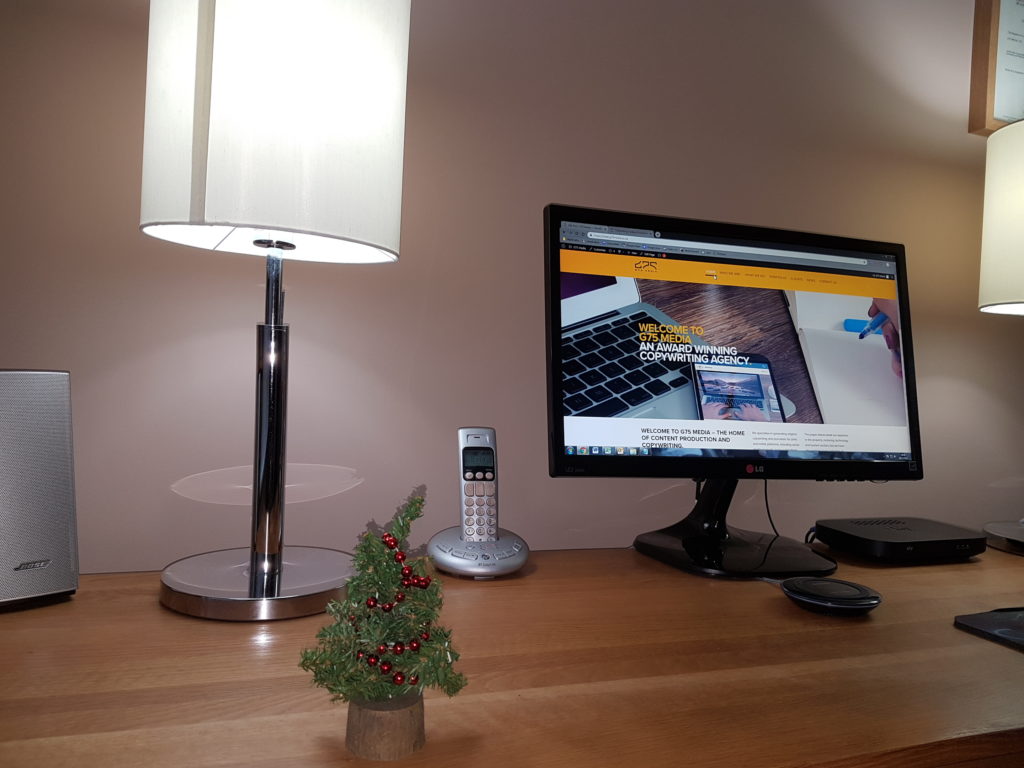
It's beginning to look a lot like Christmas in the G75 Media office...
It’s beginning to look a lot like Christmas in the G75 Media office…

G75 Media and GDPR – keeping your data safe

Later this month, the EU will roll out its General Data Protection Regulation. After four years of development, GDPR will effectively replace the UK’s 1988 Data Protection Act. As such, it will place additional regulatory burdens on companies retaining any client information on file. This can range from the names and email addresses of corporate contacts to bank account details and social media posts.

At G75 Media, we take these responsibilities very seriously. We are preparing for GDPR’s introduction on Monday the 25th, and these are some of the steps we’re introducing to protect and preserve the confidentiality of client data:

• From today, every email we send will contain an invitation to unsubscribe from future correspondence. If you reply with the word ‘unsubscribe’ in the subject line, we will immediately delete any contact information we hold relating to you.

• If six months has elapsed since we last worked with you, we will archive any sent or received electronic documentation. Data will be saved on a password-protected USB key with AES 256-bit encryption, which is stored offline in a safe.

• Current documentation and related client data (including email addresses) is stored on a password-protected drive of a desktop computer equipped with sophisticated antivirus software. We do not share client data with anyone, in any circumstances.

• Any historic databases or spreadsheets of contact information we previously held have all been deleted. This ensures any information provided to us by former clients has been securely destroyed.

• If you contact us via telephone, email, post, text message or social media, we will only communicate with you regarding work-related briefs or assignments. We will never send you marketing emails, event invitations or other unsolicited sales missives.

• We’re working towards a paperless office, and we never print out emailed documentation. Any paperwork we do receive is securely stored in a locked building until it’s no longer needed, at which point it’s destroyed in a cross-cut shredder.

We recognise there is a great deal of confusion about GDPR and its effect on small businesses around the UK. As technology bloggers, we have already been commissioned to produce a number of features on GDPR and its impact, so it’s a subject we’re familiar with. However, if you have any concerns about how we use or store client data, please don’t hesitate to ask.

Finally, if you’ve found this page while searching for information on GDPR, G75 Media has produced a number of practical guides on behalf of clients on both sides of the Atlantic. If you’d like content creating for your own company, we’ll be happy to provide you with a quote – in strict confidence, and with full adherence to GDPR regulations! You can get in touch with us here.

Easter break? Not for us!

While the rest of the UK enjoys a welcome (if rather chilly) Easter bank holiday weekend, work continues at the copywriting coalface for G75 Media. In our new role as copy editors of a national magazine, there are articles to be revised and proofread in preparation for next week. We have the usual turntable of weekly deadlines to be met – even if copy that our clients would normally upload on Monday won’t be seen til Tuesday! And there’s also the small matter of entering a national competition for freelancers, with our entry ready to be uploaded. If we’re nominated, you’ll hear about it here first…